

As a new two-dimensional material, transition metal carbon/nitride (MXene) has been reported for the first time since 2011, and has quickly attracted the attention of scientific researchers because of its excellent properties. MXene is composed of n+1 layer of transition metal atoms (M) and n layer of carbon or nitrogen (X) atoms, and its general formula can be written as Mn+1XnTx, where n is 1, 2 or 3, representing the atomic arrangement types of three MXene materials, T refers to the functional group bonded to the surface of the material. Due to the rich chemical composition of the system, more than 30 kinds of MXene have been successfully prepared, and theoretical calculations show that there are still many possible MXene to be developed. Due to the unique physical and chemical properties of MXene, it has broad application prospects in catalysis, sensing, energy storage and other fields. Studies have shown that MXene is prone to oxidative degradation in the natural environment, which limits the development of MXene materials. The composite of MXene with other materials can effectively improve the environmental stability of MXene and further expand its practical application range. Among them, the polymer has the advantages of simple preparation, low price and adjustable function, and the combination of polymer and MXene to prepare composite films has become one of the current research hotspots, which is expected to realize the large-scale application of MXene materials in industrial production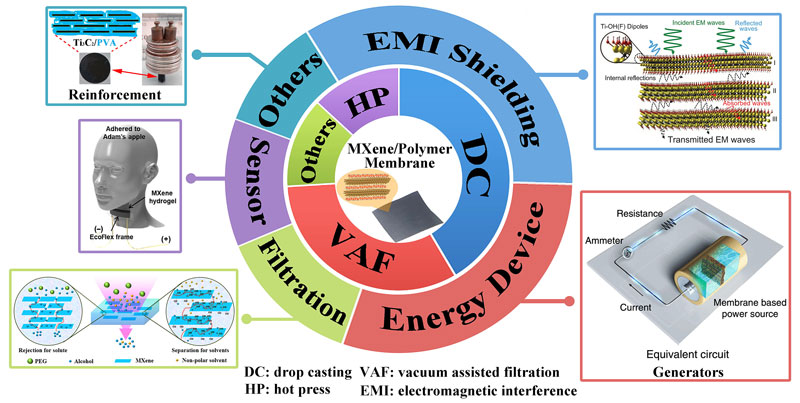
Figure 1. Summary of preparation methods and related applications of MXene/ polymer films: The size of the pie chart represents the proportion of papers related to preparation methods and practical applications in total published papers.
Recently, the research team of Zhang Han, distinguished Professor of Shenzhen University, published a paper entitled "MXene/Polymer Membranes: Synthesis, Properties, and Emerging Applications "for the first time systematically summarized the preparation, properties and practical applications of MXene/ polymer films. This review is divided into six parts: (1) The synthesis methods of MXene body: selective etching of MAX or non-Max precursors and bottom-up CVD growth method; (2) Study on the properties of MXene: electronic properties, mechanical properties and stability; (3) Preparation methods of MXene/ polymer films: vacuum assisted filtration (VAF), solution pouring film (DC), hot pressing film (HP), layer self-assembly, electrospinning and electrochemical deposition, etc. (4) Properties of MXene/ polymer films: mechanical properties, thermal properties, electrical properties and gas barrier; (5) Practical applications of MXene/ polymer films: filter media, electromagnetic shielding, sensors, supercapacitors and nanogenerators; (6) Challenges and opportunities for the development of MXene/ polymer films: The preparation process of MXene/ polymer films is summarized to provide ideas for the design of new MXene/ polymer films. For example, the quantitative preparation of MXene/ polymer films is realized by adding unintercalated MXene blocks in the polymerization process; By establishing a suitable model, the mechanism of MXene and polymer was studied, and combined with the experimental results, the effect of the synergistic effect of MXene and polymer on the properties of MXene/ polymer films was revealed. At present, the relatively mature Ti3C2 material is mainly used in the preparation of MXene/ polymer films. Considering the diversity of MXene materials, the introduction of other elements MXene materials can be explored, combined with the versatility of the polymer itself, to achieve the preparation of high-performance MXene/ polymer films.
The review paper was recently published in the Chemistry of Materials. The first author is Dr. Lingfeng Gao, a postdoctoral fellow at Shenzhen University, and the corresponding author is Zhang Han, distinguished professor at the Joint Laboratory of Optoelectronic Science and Technology of Two-dimensional Materials at Shenzhen University. This work has been supported by the National Natural Science Foundation of China, the Postdoctoral Science Foundation of China, the Science and Technology Plan Project of Guangdong Province, and the Science and Technology Innovation Fund of Shenzhen.