

Following an article on Ti3C2 published in Science last year, Yury Gogotsi, an ultra-high volume-specific capacity Ti3C2 supercapacitor, reported in Nautre this year. Previous Science has only been able to achieve high volume specific energy in thin film form. This work provides a method to produce a two-dimensional material called Play-doh, which can be made into a variety of shapes on demand while maintaining its ultra-high volume specific energy, promising for industrial applications.
Safe and powerful energy storage devices are becoming increasingly important. Charging times of seconds to minutes, with power densities exceeding those of batteries, can in principle be provided by electrochemical capacitors-in particular, pseudocapacitors 1,2 . Recent research has focused mainly on improving the gravimetric performance of the electrodes of such systems, but for portable electronics and vehicles volume is at a premium 3 . The best volumetric capacitances of carbon-based electrodes are around 300 farads per cubic centimetre 4,5 ; hydrated ruthenium oxide can reach capacitances of 1,000 to 1,500 farads per cubic centimetre with great cyclability, but only in thin films 6 . Recently, electrodes made of two-dimensional titanium carbide (Ti 3 C 2 , a member of the `MXene` family), produced by etching aluminium from titanium aluminium carbide (Ti 3 AlC 2 , a
`MAX` phase) in concentrated hydrofluoric acid, have been shown to have volumetric capacitances of over 300 farads per cubic centimetre 7,8 .
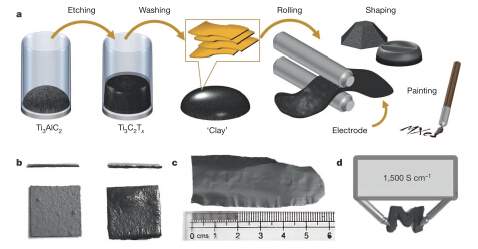
Here we report a method of producing this material using a solution of lithium fluoride and hydrochloric acid. The resulting hydrophilic material swells in volume when hydrated, and can be shaped like clay and dried into a highly conductive solid or rolled into films tens of micrometres thick. Additive-free films of this titanium carbide `clay` havevolumetric capacitances of up to 900 farads per cubic centimetre, with excellent cyclability and rate performances. This capacitance is almost twice that of our previous report 8 , and our synthetic method also offers a much faster route to film production as well as the avoidance of handling hazardous concentrated hydrofluoric acid.
Yury Gogotsi's New book NATURE!!
2022 09/26